

Lead Your Team Through Employee Reintegration With Confidence
The ARrIVE Reintegration Framework provides supervisors with coaching, communication strategies, and leadership support when employees return from mental health treatment, addiction recovery, or extended medical leave.
Right Now, You're Leading This Transition Alone

Your team member returns next week, and you're not sure how to handle it. What do you say in that first conversation? How do you balance compassion with productivity expectations? How do you help your team adjust without making it awkward?
You're coordinating with HR on the paperwork side, but nobody's helping you with the leadership challenge—the actual human dynamics of bringing someone back into the team after they've been gone for treatment or medical leave.
So you're winging it. Every conversation feels uncertain. Your team is watching how you handle this, but you don't have a clear framework. The adjustment period drags on for months because there's no structured approach.
And here's what keeps you up at night: What if this fails? What if your returning employee struggles and eventually leaves? That's $50,000-$150,000+ in replacement costs, lost institutional knowledge, and a team that's just watched their leader fail at a critical moment.
You need a coach. You need a framework. You need someone who's been on both sides of this challenge.

Imagine Leading This Transition with Clarity and Confidence
Your returning employee is back at their desk and productive. Your team has found its rhythm. And you? You're sleeping at night because you have a proven framework handling the communication and team dynamics.
With ARrIVE Reintegration Coaching, you get:

Leadership Coaching Support
You're not figuring this out alone. You have a coach with 22 years of military leadership experience and personal recovery experience guiding you through every phase.

Protected Human Capital Investment
You retain your trained employee (avoiding $50K-$150K+ replacement costs) while maintaining team productivity throughout the transition

Structured Communication Frameworks
Clear protocols for that first conversation, ongoing check-ins, team communications, and addressing challenges as they arise—no more guessing what to say
Enhanced Leadership Capability
You'll build skills that serve you far beyond this situation—handling difficult conversations, facilitating team transitions, leading with both empathy and accountability

Rapid Team Adjustment
What typically takes 6-8 months of awkward interactions gets compressed into a focused 6-8 week structured process with clear milestones
Peer Recovery Perspective
Insights from someone who's been on both sides—the military leader bringing troops back from crisis AND the person returning after treatment
Most importantly? You stop second-guessing every decision and start leading this transition with confidence.
I've Been on Both Sides of This Challenge
I know what you're facing. That mix of wanting to do the right thing while feeling completely unprepared. The pressure of maintaining team productivity while supporting someone's recovery. The weight of leading through something you've never been trained for.

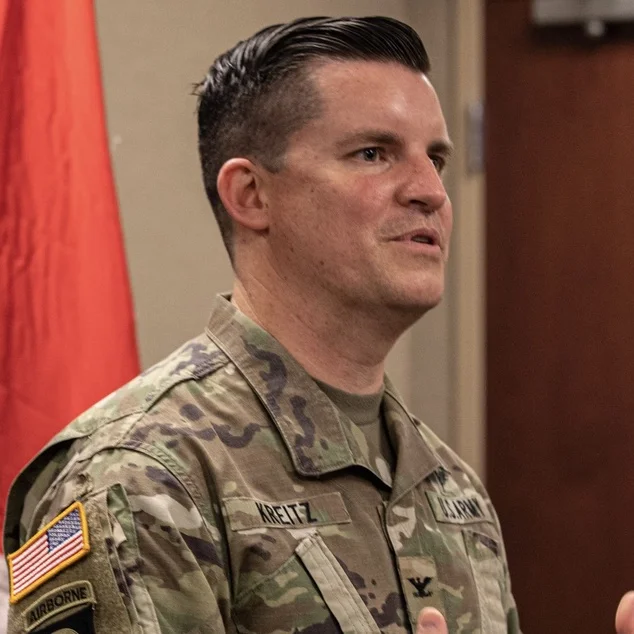
I'm Eric Kreitz, founder of Renovium Leadership.
I spent 22 years in U.S. Army leadership, including 17 years as a Psychological Operations Officer, where I learned that bringing people back after crisis requires clear frameworks and structured communication—not just good intentions.
But I also know this from the other side. I've been the person coming back after treatment. I understand what actually helps versus what sounds good in theory.
Today, I combine military leadership experience, professional coaching credentials, peer recovery specialist training (Texas), and lived recovery experience to coach supervisors through one of their toughest leadership challenges.
Credentials:
Colonel (Ret.), U.S. Army - 22 years, 17 in Psychological Operations
Professional Coach (ICF Credentialed)
Peer Recovery Specialist Training (Texas)
Personal Recovery Experience
Doctoral Student, Executive Leadership (University of Charleston)
Creator of the ARrIVE Reintegration Framework
Important Note on Scope:
I provide leadership coaching and communication frameworks. You'll continue working with your organization's HR and legal teams on employment law, accommodation requirements, and compliance matters. My role is coaching you through the human and leadership aspects of reintegration—not providing legal or HR advice.
You don't have to lead this transition alone. That's what I'm here for.
How the ARrIVE Coaching Framework Works
A structured coaching framework that compresses what typically takes 6-8 months of trial-and-error into a focused 6-8 week guided process.
A
RR
Phase 1: Assessment (Week 1-2)
I start with comprehensive assessment through coaching conversations with you. Together I explore the specific dynamics of your situation—your returning employee's role, your team's needs, your organizational context, and your concerns as their supervisor. This creates a clear foundation for your leadership approach before jumping to solutions.
Phase 2: Resource Readiness (Week 2-3)
I translate assessment insights into concrete support systems. Together I identify the communication frameworks, leadership approaches, and team facilitation strategies you'll need. I'll help you prepare for key conversations, develop team communication plans, and create clear expectations—while you coordinate the policy/legal aspects with your HR team.
I
Phase 3: Implementation (Weeks 3-6)
The active reintegration period begins. I execute the plan together with regular coaching sessions and real-time support. You'll have frameworks for those difficult conversations, progressive workload strategies, and team coordination approaches. I adapt as needed based on what's actually happening—not what I assumed would happen.
V
Phase 4: Vigilance (Weeks 6-7)
Once basic stability is achieved, I shift to ongoing monitoring. I help you maintain active attention to conditions that might affect sustainability—organizational changes, team dynamics, individual indicators. This proactive approach enables intervention before small challenges become big problems.
E
Phase 5: Equilibrium (Week 8+)
I transition to sustainable long-term integration. The reintegration moves into standard organizational operations. I focus on capturing insights, building your capability for future situations, and ensuring this success becomes part of how your team operates—not a special exception that required external support.
Timeline
6-8 weeks from assessment to sustainable integration
Format
1-on-1 coaching sessions + frameworks + real-time support
Focus
Leadership, communication, and team dynamics (You handle HR/legal with your organization's support)


Why Leadership Coaching Makes the Difference in Employee Reintegration
When an employee returns from mental health treatment, addiction recovery, or extended medical leave, most supervisors are given the HR paperwork but zero support for the actual leadership challenge. They're expected to figure out the communication piece, manage team dynamics, balance compassion with productivity, and navigate months of uncertainty—all while doing their regular job. It's no wonder that without structured support, these transitions often take 6-8 months of awkward adjustment, and roughly 40% end in the employee leaving.
The ARrIVE Reintegration Framework provides what's been missing: structured leadership coaching for supervisors navigating these complex transitions. The five-phase approach (Assessment, Resource readiness, Implementation, Vigilance, Equilibrium) moves supervisors from reactive crisis management to proactive coaching on communication frameworks, team facilitation strategies, and leadership approaches that actually work. Instead of guessing what to say in difficult conversations, supervisors have proven frameworks and a coach with both military leadership experience and personal recovery experience guiding them. Instead of the adjustment period dragging on indefinitely, I compress it into a focused 6-8 week coaching engagement with clear milestones.
This approach recognizes that successful reintegration isn't just about paperwork and accommodations (that's your HR team's domain)—it's about leadership. It's about how you have that first conversation with your returning employee. How you help your team adjust. How you balance support with accountability. How you maintain productivity while showing compassion. These are leadership skills, and like all leadership skills, they can be coached and learned through the ARrIVE framework.
Organizations whose supervisors receive this coaching support report faster team adjustment, maintained productivity during transitions, increased leadership confidence, and protected human capital investments. But perhaps most importantly, supervisors report feeling prepared and confident instead of anxious and alone. Because when you have a coach and a proven framework, the uncertainty disappears. You're working with your HR and legal teams on the compliance side while I coach you through the human and leadership side—and together, I set your team up for success.

Free Guide
The Supervisor's First Conversation Framework
Download the communication framework that helps you navigate that critical first conversation when your employee returns after treatment or medical leave—with confidence, not anxiety.
In the Guide:
What to say (and not say) in the first conversation
How to balance compassion with clear expectations
Communication frameworks for ongoing check-ins
Red flags to watch for and how to address them
When to involve HR vs. when to handle it as a supervisor
Download the free guide:
How I Work With Your Organization
Renovium Leadership provides executive coaching and leadership development focused on the human dynamics of employee reintegration. I coach supervisors on communication strategies, team facilitation, and leadership approaches during transitions.
I do not provide:
Legal advice or interpretation of employment law
HR consulting or policy development
Medical or clinical advice
FMLA, ADA, or HIPAA compliance guidance
You will continue working with:
Your HR department on accommodation requests and policies
Your legal counsel on compliance and employment law questions
Healthcare providers on medical aspects of recovery
My role is coaching you—the supervisor—through the leadership and communication challenges. I work alongside your organization's HR and legal teams, not in place of them.
FAQs
-
The ARrIVE Reintegration Strategy scales to meet your specific needs through three service tiers:
Tier 1 - Supervisor Preparation (Employee Prefers Privacy)
Your employee doesn't want to share details about their absence. The ARrIVE model prepares YOU to lead effectively with limited information through clear protocols, professional language, and confident navigation frameworks.Tier 2 - Collaborative Planning (Employee Participation)
Your employee wants involvement in their return. ARrIVE brings you and your employee into collaborative planning that honors their voice while protecting privacy. Together, we create a reintegration plan that works for everyone.Tier 3 - Team Support (Supervisor + Employee or Full Team)
The entire team needs clarity about workflows and expectations. ARrIVE expands to help your team adjust responsibilities and maintain cohesion while respecting confidentiality boundaries. Everyone gets clarity without compromising privacy.Each approach uses the same five-phase ARrIVE framework (Assessment, Resource Readiness, Implementation, Vigilance, Equilibrium), adapted to your situation and your employee's involvement preference.
-
Nothing. And that's exactly the point.
I'm not your HR department, attorney, or healthcare provider. I don't provide legal advice, medical opinions, or compliance guidance. That's between you, your HR team, and your legal counsel.
What I do provide is leadership coaching and communication frameworks. I help you navigate the human dynamics of reintegration—what to say in that first conversation, how to support your employee while protecting team productivity, and how to lead confidently when you have limited information.
The ARrIVE framework complies with HIPAA, FMLA, and ADA requirements by focusing on operational considerations rather than medical details. You'll learn to ask the right questions, establish appropriate boundaries, and lead effectively regardless of what you know—or don't know—about your employee's circumstances.
-
That's the right question, and it's exactly why the ARrIVE framework exists.
Without structure, reintegration typically drags on for 6-8 months of awkward interactions, gradual adjustments, and uncertain outcomes. The ARrIVE Reintegration Strategy compresses that timeline into a focused engagement that gets your employee, your team, and you back to effective functioning rapidly.
Each situation is different. A straightforward return might move quickly through the five phases, while a more complex scenario with team dynamics or graduated workload needs more time. What remains consistent is the structured approach that eliminates months of uncertainty and gets everyone to stability faster than leaving it to chance.
The value isn't in following a predetermined schedule—it's in having clear protocols from day one, giving your employee structured support at their chosen involvement level, and maintaining team productivity throughout the transition.
Consider the alternative: losing $50,000 to $200,000 in replacement costs if the reintegration fails, months of decreased productivity, and the loss of institutional knowledge that walks out the door.
-
Life doesn't follow a script, and neither does reintegration.
The ARrIVE framework includes built-in flexibility through what I call the "Mini-ARrIVE Protocol"—a streamlined approach for addressing emerging challenges without starting from scratch. When something shifts (workload pressures increase, team dynamics change, your employee faces a setback), I'll help you quickly assess the new situation, identify resources, and adjust the plan.
This adaptive approach is baked into the Vigilance phase, which focuses on monitoring conditions that create risks or opportunities rather than just tracking symptoms. You'll learn to spot warning signs early and respond proactively before problems fully develop.
The result: you're prepared for uncertainty without being paralyzed by it. You'll have frameworks for handling whatever comes up, maintaining momentum even when circumstances change.